
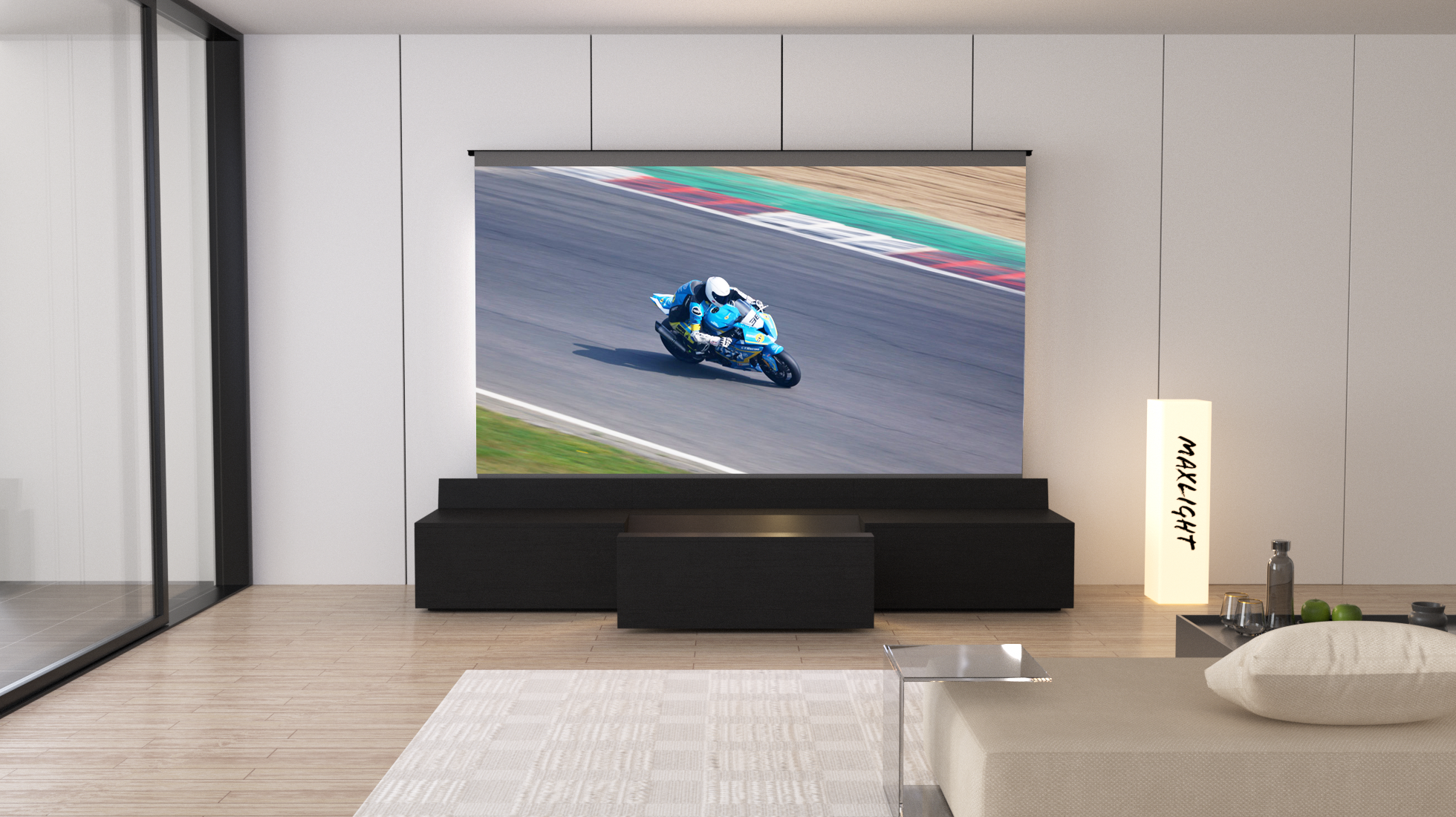
Bespoke Cinema Furniture
Custom Projector Cabinets
Designed around your room, your projector and your screen. Motorised, fully concealed cinema furniture built to your exact dimensions, finish and equipment layout.
Price on Application
When a standard cabinet won't do
Our off-the-shelf cabinets suit most mainstream ultra short throw setups. But plenty of rooms don't play by those rules — an unusually deep projector body, a longer throw ratio, a required viewing height, a listed building, a difficult staircase, or a wall width that simply isn't standard. That's where a bespoke build comes in.
Built to your dimensions
Width, height and depth designed around your room and your seating position rather than a fixed catalogue size.
Built around your projector
Deeper cabinets and custom drawer travel for projectors that won't fit a standard UST cabinet.
Built around your kit
Compartments sized for your amplifier, media boxes and AV equipment, with ventilation and cable routing planned in.
See the system move
One action opens the whole thing. The projector drawer slides out, the screen cover opens, and the floor rising screen elevates — then reverses when the projector powers down.
The cabinet in operation, opening and closing.
Mechanism and installation detail.
Two bespoke routes
Both are custom-made to order. The right one depends on how much of the system you want integrated and how the projector needs to move.
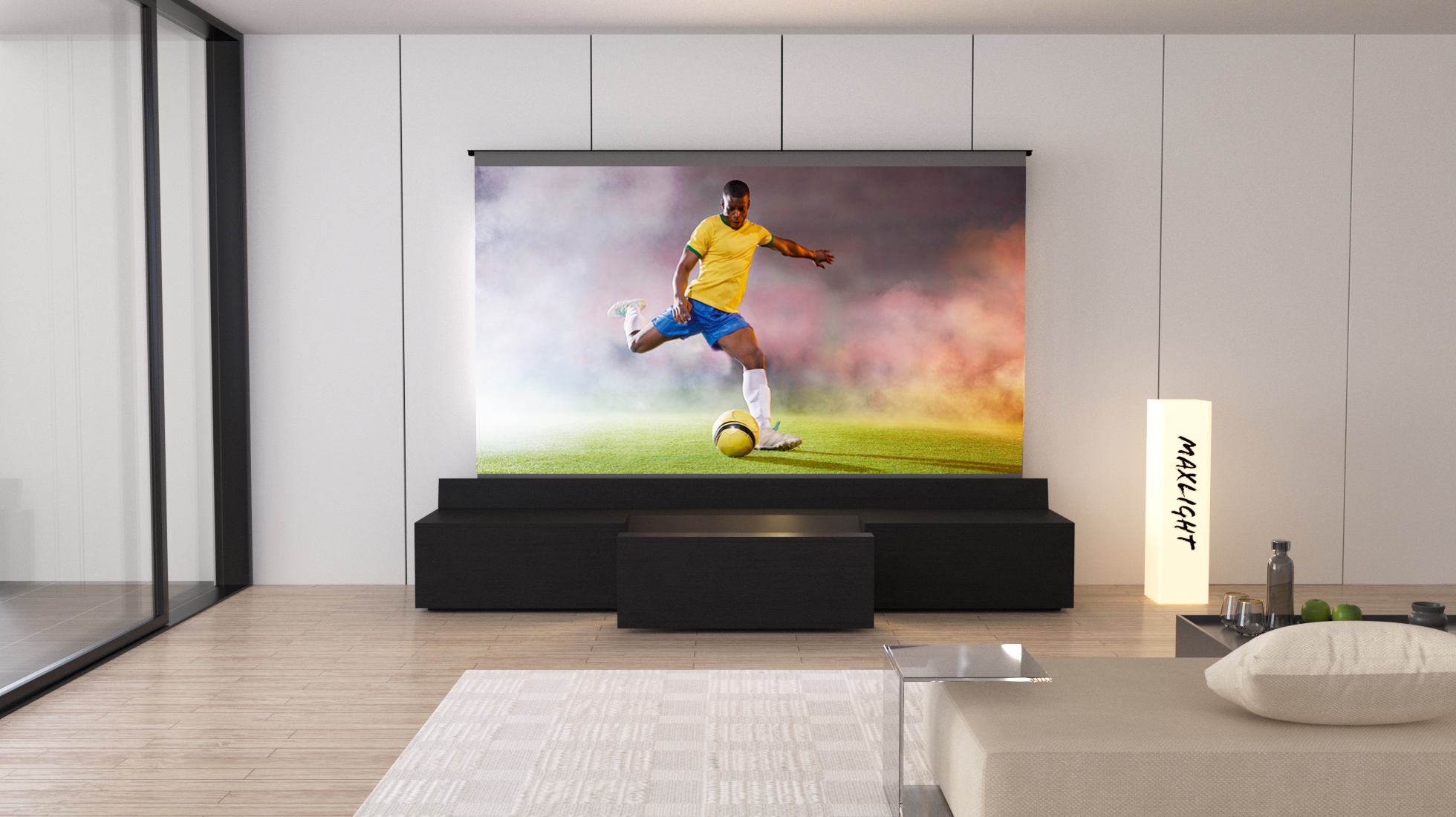
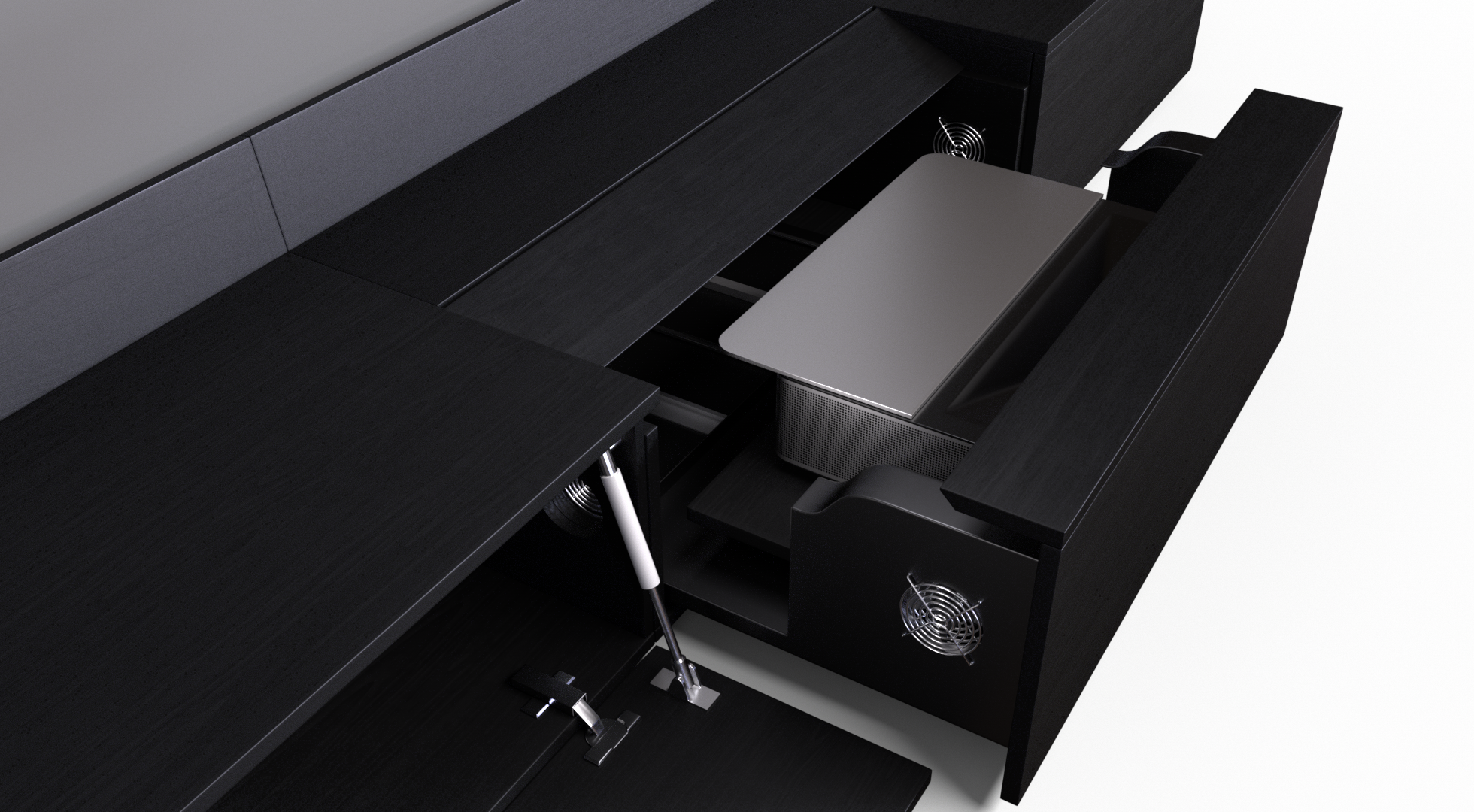
Engineered inside, not just outside
The finish is what you see. The engineering is what makes it work for the next ten years.
Ventilation planned per compartment
Projectors and amplifiers generate heat. Extraction and airflow are designed around the actual equipment going in, not assumed.
Cable routing built in
Pre-cut access points organise power, HDMI and AV cabling between modules and out through the rear of the cabinet.
Structural dividers where needed
Long runs get vertical panels to stop the top and base sagging. Structural, not optional storage.
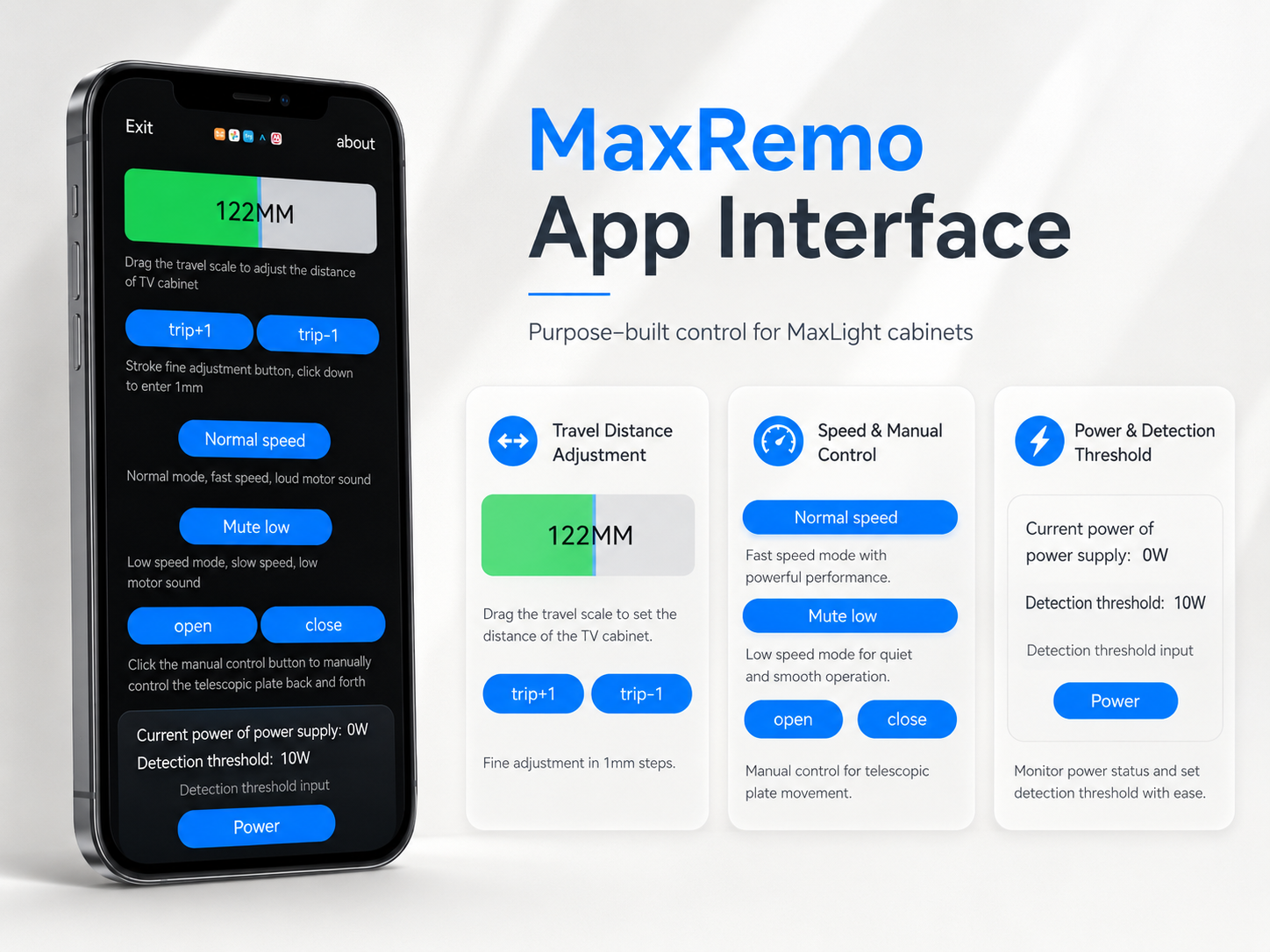
Control it from your phone
A dedicated iOS and Android app connects over Bluetooth and gives you direct control over setup, movement and power behaviour.
Travel distance
Set drawer travel and fine-tune in 1mm steps for the installation.
Manual open / close
Operate the cabinet by hand, independent of the automatic sequence.
Speed mode
Choose between faster movement and quieter, slower operation.
Power detection
Adjust the trigger threshold to suit your projector's standby behaviour.
How a custom cabinet is built
A bespoke cabinet is a design project, not a stock item. The process is deliberately staged so nobody pays for design work before we know the project is achievable.
Send your requirements
Room, projector, screen size, equipment and finish. The form below covers everything we need.
Free feasibility check
We review it with the factory and confirm whether the build is physically achievable. No charge, no obligation.
Design stage
Once you're happy to proceed, the design fee is paid and the factory prepares a draft drawing.
Drawing & firm quotation
You receive the draft drawing and a firm price based on the finalised design. Build and delivery follow on approval.
Why we quote on application
We're often asked for a "from" price by screen size. In practice, screen size alone tells us very little about what a cabinet will cost — two 150" cabinets can differ substantially depending on what's inside them and how they're built. Every cabinet is designed individually, and the price depends on:
Overall dimensions
Cabinet width, height and depth.
Screen & material
Model, size, ALR or standard white, acoustic or solid.
Projector & position
Model, body size, throw ratio and where it sits.
Movement mechanism
Motorised drawer, slider, or no mechanism at all.
Internal equipment
Compartment sizes, ventilation, access and cable management.
Structure & finish
Reinforcement, materials, surface finish and stability requirements.
Delivery access
Route into the room, staircases, doorways and lifting.
Fixing restrictions
Whether the cabinet can be secured to the building at all.
Lead time
Production and shipping schedules for the specification chosen.
What we need from you
The more of this you can supply up front, the faster we can tell you whether the project works and roughly what it costs. Rough answers are fine to start — we'll follow up on the rest.
The room
• Finished floor-to-ceiling height
• Total available wall width
• Required height of the visible image from the floor
• Whether fixing to walls, floors or ceilings is permitted
• Ambient light conditions and whether they can be controlled
• Any listed building or planning restrictions
The system
• Projector make and model (or that it's still to be chosen)
• Preferred screen size and whether UST or standard throw
• Throw distance and vertical offset, calculated at the correct aspect ratio
• Required cabinet height and preferred depth
• Preferred finish
• Whether doors, open compartments or removable panels are needed
The equipment inside
• Exact list of equipment to be installed
• Make and model of each item
• Width, height and depth of each item
• Whether ventilation is required
• Whether front or rear access is needed
"Media boxes and other AV equipment" isn't enough to size a cabinet — we need the actual items.
The delivery route
• Narrowest clear width along the route
• Minimum vertical headroom
• Turning diameter of any spiral or winding staircase
• Landing dimensions and all door widths and heights
• Fixed handrails, posts or other obstructions
• Photographs and ideally a video of the full route
• Whether window access or lifting equipment is possible
Check your access before you pay for design
This is the single most common reason a custom cabinet project falls over, and it's worth ten minutes of your time before anything else happens.
Side cabinets flat-pack. The centre section doesn't.
Side cabinets ship as modular panels and assemble in the room. The centre module contains the projector mechanism, motor, rails, wiring and alignment components — it has to be assembled, aligned and tested at the factory and delivered as one complete unit.
Assume a bulky box, not a thin one
Final dimensions come out of the design stage, but for an initial check assume the centre section is at least 1000mm wide × 800mm deep × 600mm high, and larger for bigger screen sizes. Getting an 85" TV upstairs doesn't prove it — a TV is thin and can be tilted and rotated. A cabinet module can't.
Three things worth getting right early
ALR screens are direction-specific
A UST ALR screen accepts light arriving steeply from below and rejects light from above. A standard-throw ALR screen expects light from a conventional direction. They aren't interchangeable — pairing a UST projector with a long-throw ALR screen gives a dark, uneven image, and moving the projector further back doesn't change its optics.
Check the aspect ratio in your calculations
Many projectors are natively 16:10 but run happily in 16:9. If your throw calculations were done at 16:10 and the screen is 16:9, the image height, projector position, throw distance and vertical offset all shift. Run the calculation at the ratio you're actually buying.
Long cabinets need vertical dividers
"No shelving" is fine — no horizontal shelves or storage levels. But a long side cabinet can't be one open unsupported span. Vertical structural panels keep the top and base from sagging over time. These are structural, not optional storage.
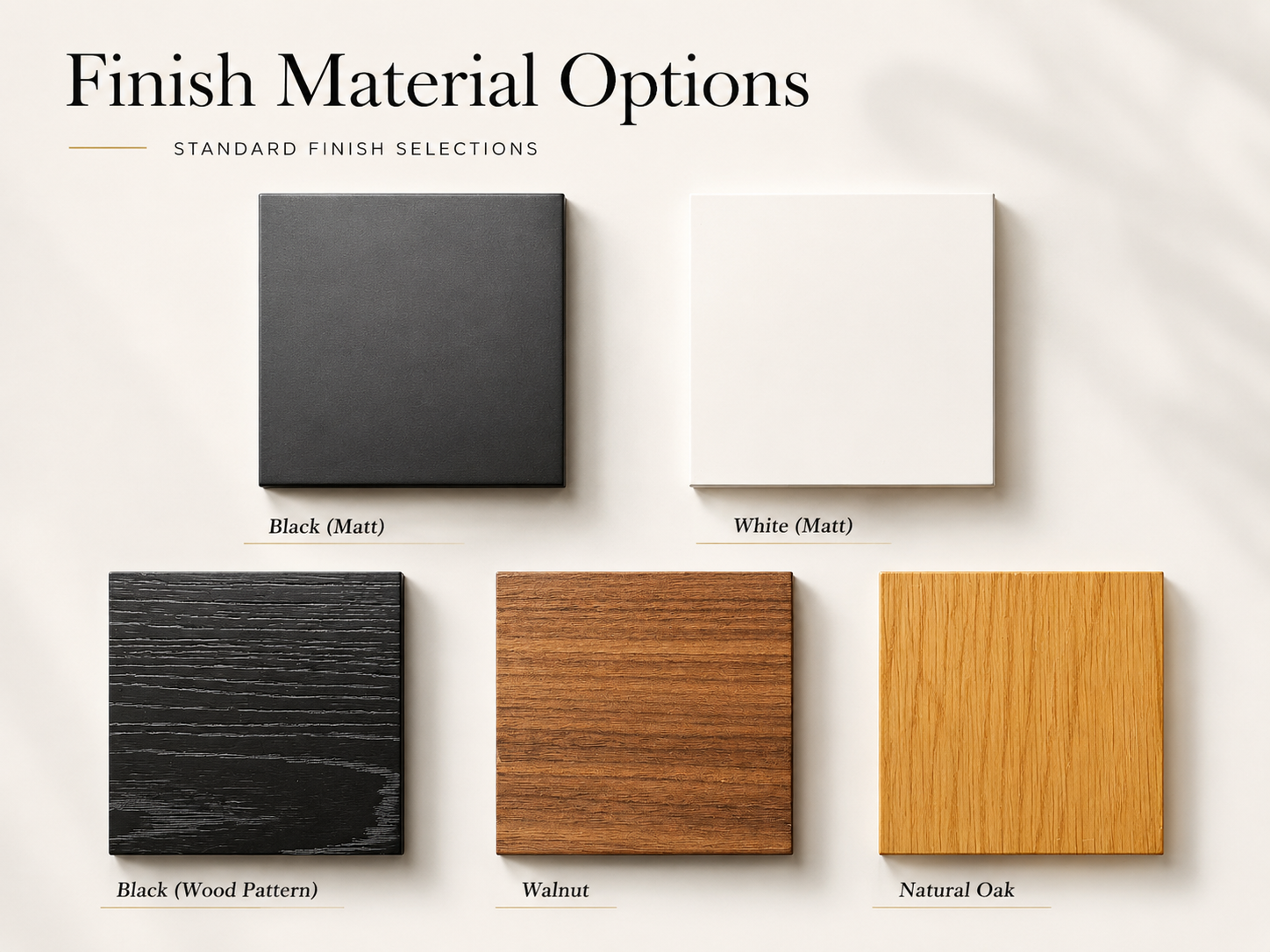
Finish options
The standard furniture-friendly finish range, plus bespoke colours and surfaces on selected projects.
Indicative lead times
Custom cabinets are built to order and shipped from the factory. Plan your project around these figures — they're typical, not guaranteed, and confirmed at the quotation stage.
| Stage | Typical duration | Notes |
|---|---|---|
| Feasibility review | Free | No obligation. Timeframe depends on the information supplied. |
| Design & draft drawing | After design fee | £360 excluding VAT per cabinet. |
| Production | Approx. 6–8 weeks | Larger cabinets and larger screens sit at the upper end. |
| Shipping | Approx. 10 weeks | Factory to UK. |
| Total, design approval to delivery | Approx. 16–18 weeks | Delivery included in quoted cabinet prices. |
When a custom cabinet isn't the right answer
We'd rather tell you this up front than take an order that doesn't serve you well.
A factory cabinet earns its place when there's a mechanism
Factory assembly matters most where there's a motorised projector drawer, a moving platform or an integrated mechanism that needs to be aligned and tested before it leaves the floor. That's what you're paying for.
Plain concealment furniture may be better made locally
If your cabinet has no projector movement system and exists purely to conceal a screen housing and hold some AV kit, a local joiner or bespoke furniture maker can measure the room, build in situ, work around access restrictions and match your existing furniture — often faster and more cheaply than shipping a large factory-assembled unit. We're happy to supply the screen and its technical drawings so they can design the furniture around it.
Common questions
Can you build a cabinet to any size?
Within reason, yes. Cabinet height, depth, length, finish, projector position and screen position can all be customised. What we can't do is confirm a size is achievable without knowing the room, the equipment and the delivery route. That's what the free feasibility review is for.
Why won't you give me a price by screen size?
Because screen size alone doesn't determine the cost. Cabinet dimensions, internal equipment layout, mechanism type and structural requirements all move the number significantly. We'd rather give you a meaningful figure once we know what we're building than a headline number that turns out to be wrong.
Is the design fee refundable?
No. The £360 excluding VAT design fee covers the design work and draft drawing, is non-refundable once that work begins, and is not deducted from the final cabinet cost. It's only requested once we've confirmed the project is feasible.
Can I return a custom cabinet?
No. Custom cabinets are made specifically for your project and are non-returnable once the order is confirmed. This is why we're thorough at the feasibility and design stages.
Do I have to buy the projector and screen from you?
Not necessarily, but we do need the exact make and model of both to design the cabinet around them. If you'd like us to supply the whole system, the all-in-one route packages the cabinet, screen and projector together.
What if my projector isn't a standard UST model?
Tell us the model. Projectors with longer throw ratios or deeper bodies need a deeper cabinet and different drawer travel — that's precisely the kind of project a custom build exists for. If the projector sits outside the cabinet entirely, the cabinet becomes concealment furniture, and it's worth reading the section above on when a local joiner may serve you better.
Can the cabinet be made longer than standard?
Yes. Additional side cabinet modules can extend the furniture run for larger wall layouts. Bear in mind that longer side cabinets require vertical structural dividers.
Which UST projectors are compatible?
Mainstream ultra short throw projectors, typically around 0.21:1 throw ratio or above. Final compatibility depends on the projector's body size, lens position, cable connection position, ventilation direction, screen size and the installation environment. The projector has to physically fit the centre compartment before throw distance is even assessed.
Can I add a conventional TV as well?
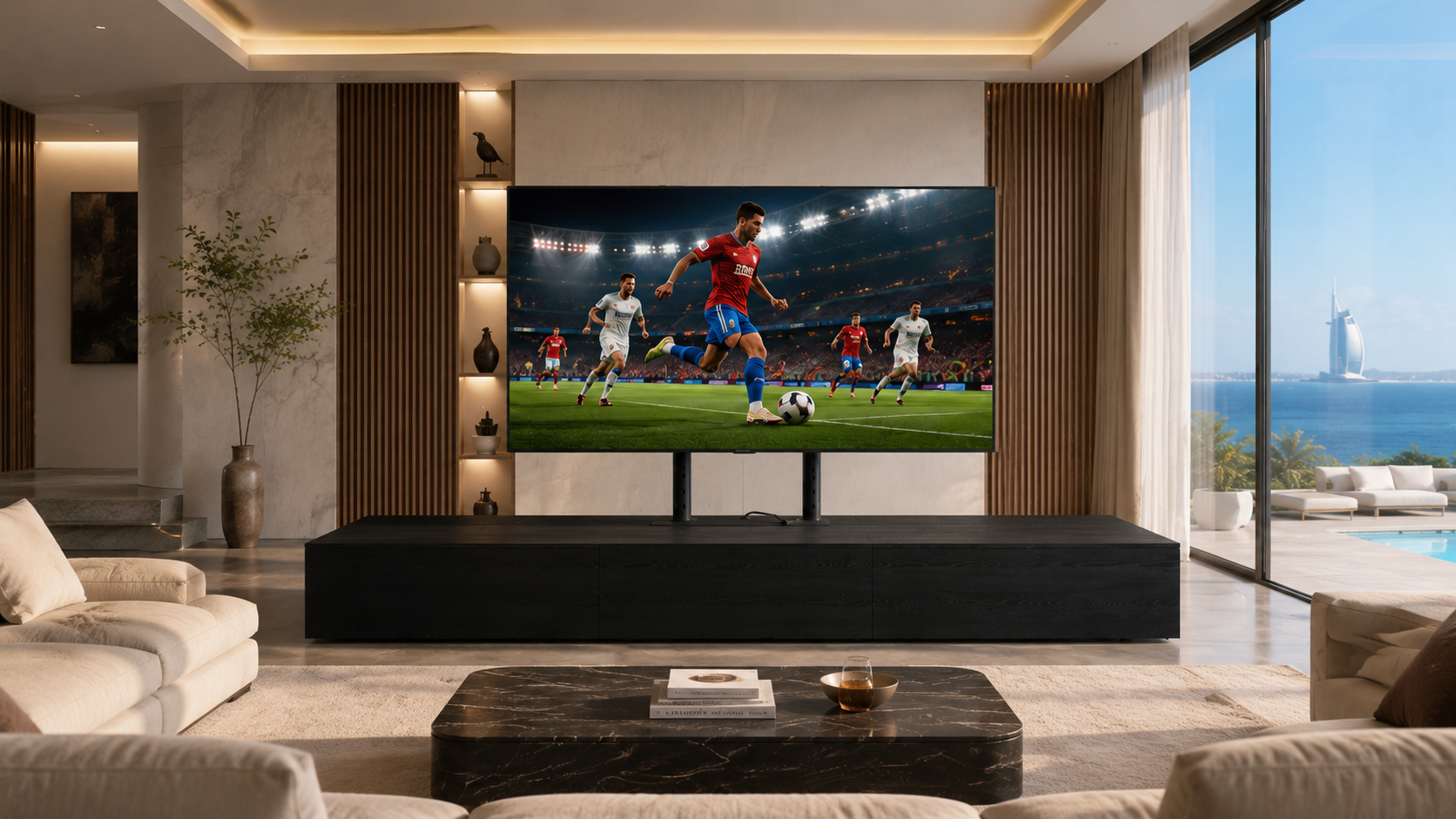
Yes. An optional rear attachment module mounts a TV up to 70" on height-adjustable support poles with a universal VESA bracket, without fixing anything to the wall. You get a TV for daily viewing and the floor rising screen for cinema. It's specified at order stage rather than added later.
Start your custom cabinet enquiry
Fill in what you know. Anything you're unsure of, leave blank or tell us it's undecided — we'll come back to you. The feasibility review is free and there's no obligation to proceed.
Prefer to talk it through?
Custom projects are often easier to scope over the phone. Tell us about the room and we'll tell you honestly whether a bespoke cabinet is the right answer.